


Your shopping cart is empty!
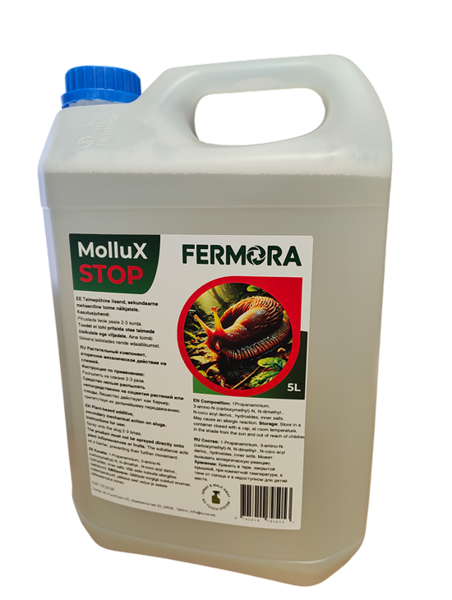
"Fermora Mollux Stop" slug repellent (5000 ml)
New
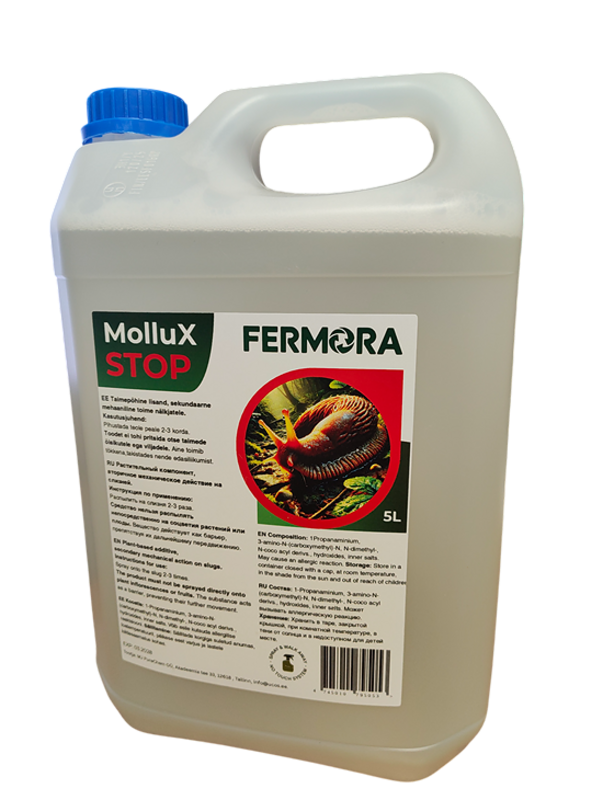
“Fermora Mollux Stop” — a plant-based molluscicide: a natural barrier against slugs.
This innovative product represents an environmentally safe alternative to harsh chemicals. The preparation is based on a coconut oil derivative (cocamidopropyl betaine), which has a secondary mechanical effect on pests. Upon contact with a slug, the active substance disrupts the surface tension of its protective mucus, creating a physical barrier and preventing further movement. This is a “humane” and effective way to protect your garden without poisoning the soil with heavy metal breakdown products.
Instructions for use:
Spray the product evenly directly onto the slug 2—3 times. The substance creates an enveloping layer that deprives the pest of the ability to glide over the surface.
Attention: the preparation must not be sprayed directly onto the inflorescences or fruits of plants to avoid altering their taste or damaging delicate tissues.
Composition and safety.
Main component: 1-Propanaminium, 3-amino-N-(carboxymethyl)-N, N-dimethyl, N-coco-acyl derivatives, hydroxides, inner salts (surfactant based on coconut oil fatty acids). Despite its natural origin, the product may cause an allergic reaction upon contact with the skin.
Storage: store in the tightly closed original packaging at room temperature. Protect from direct sunlight. Keep out of the reach of children.
This innovative product represents an environmentally safe alternative to harsh chemicals. The preparation is based on a coconut oil derivative (cocamidopropyl betaine), which has a secondary mechanical effect on pests. Upon contact with a slug, the active substance disrupts the surface tension of its protective mucus, creating a physical barrier and preventing further movement. This is a “humane” and effective way to protect your garden without poisoning the soil with heavy metal breakdown products.
Instructions for use:
Spray the product evenly directly onto the slug 2—3 times. The substance creates an enveloping layer that deprives the pest of the ability to glide over the surface.
Attention: the preparation must not be sprayed directly onto the inflorescences or fruits of plants to avoid altering their taste or damaging delicate tissues.
Composition and safety.
Main component: 1-Propanaminium, 3-amino-N-(carboxymethyl)-N, N-dimethyl, N-coco-acyl derivatives, hydroxides, inner salts (surfactant based on coconut oil fatty acids). Despite its natural origin, the product may cause an allergic reaction upon contact with the skin.
Storage: store in the tightly closed original packaging at room temperature. Protect from direct sunlight. Keep out of the reach of children.
* Slugs in gardens multiply under high humidity and moderate temperatures. They are very moisture-loving and die in the absence of moisture. They damage seedlings and mature plants of cabbage, lettuce, cucumbers, tomatoes, carrots, radishes, potatoes, peas, beans, as well as young shoots and fruits of berry and fruit crops and ornamental plants. They cause the greatest harm in the second half of summer, eating out hollows in heads of cabbage, tubers, fruits, and berries.
Slugs are nocturnal, and during the day they hide in cool places under clods of earth, boards, etc. Slugs can be collected manually from under various shelters (boards, damp rags, large leaves) laid out on the site among the plants. This is done for several days in a row. You can place baits made of watermelon, melon, pumpkin, and zucchini rinds between the rows. At dawn, the slugs are collected and destroyed. If there are many slugs, the soil under the plants is dusted with crushed superphosphate (30—40 g/m²) or slaked lime (or a mixture of lime and tobacco dust).